
How much should you budget for a new patio?
For an initial reference, Unilock’s paver patio cost guide puts a 400-square-foot installation at about $12,000–$16,000, or $30–$40 per square foot. This is a manufacturer’s general benchmark, not a Dutchess County price survey or an All American quote. Your yard and chosen scope may put the total outside that range.
If you are planning a patio in Hopewell Junction or elsewhere in Dutchess County, separate the budget into the paved area, the work needed to support it, and optional features. That makes it easier to see what you can change and what your yard needs regardless of the finish.
What size does your budget need to cover?
The table multiplies each footprint by that published rate. These are arithmetic illustrations, not size-specific estimates.
| Patio footprint | Illustrative total |
|---|---|
| 12 × 16 ft · 192 sq ft | $5,760–$7,680 |
| 15 × 20 ft · 300 sq ft | $9,000–$12,000 |
| 20 × 20 ft · 400 sq ft | $12,000–$16,000 |
Smaller patios may have different unit costs: deliveries, setup, and access still need to be covered. Confirm the installed scope; these totals are not package prices.
Lay out your table, chairs, and walking routes at their actual sizes. If a smaller footprint still leaves comfortable room to use them, ask for that alternative. Our patio layout ideas can help you decide which areas you will use every day.
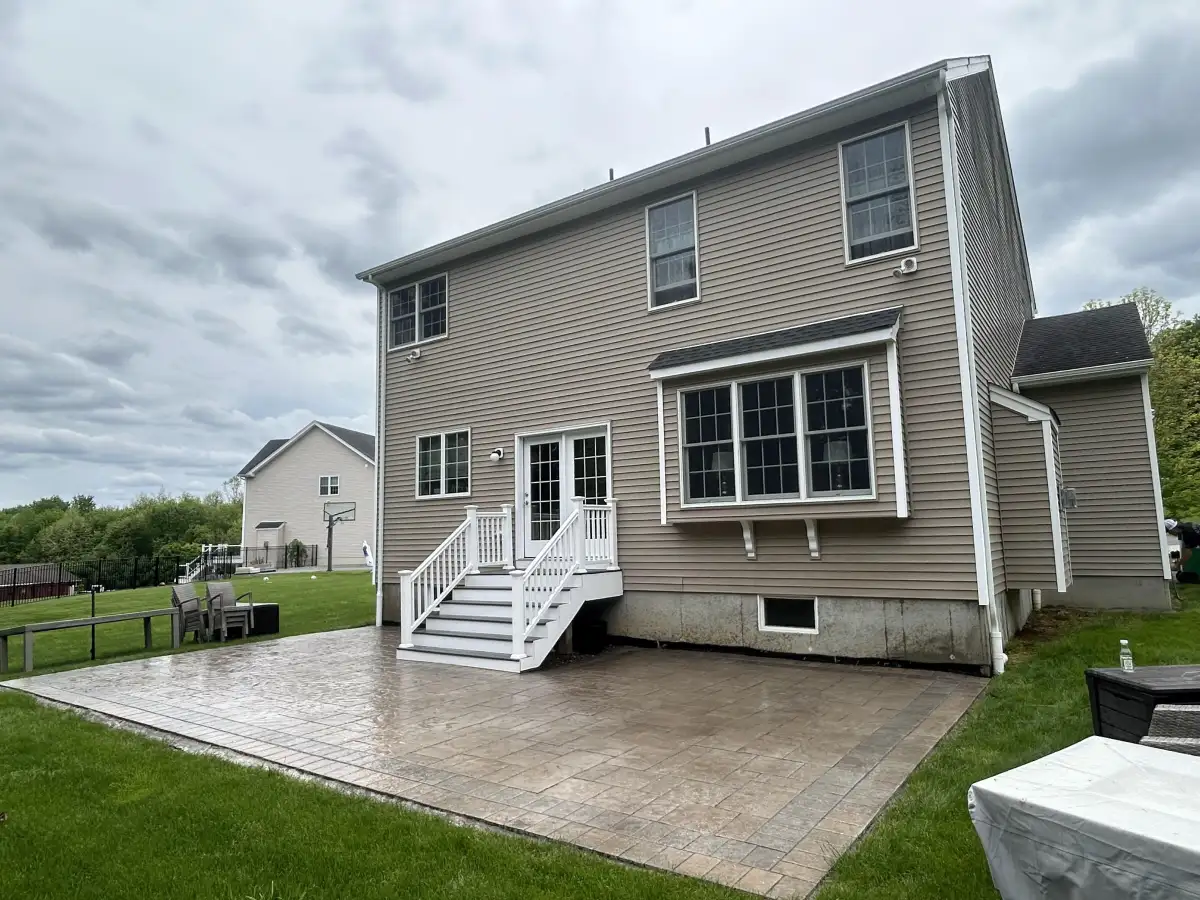
Why patios of the same size can have different prices
The visible paving is one part of the work. For concrete pavers, the Concrete Masonry & Hardscapes Association’s application guide explains that base thickness depends on soil strength, drainage, climate, and traffic loads. A standard square-foot allowance cannot establish the preparation your own yard needs.
- Replacing an existing surface: identify what must come out, where removed material goes, and whether disposal is included.
- Getting into your backyard: show gate openings, narrow side yards, slopes, and the delivery or staging area. Include the condition in which the access route will be left.
- Supporting the finished level: excavation, base construction, edge support, steps, and any retaining work belong in the scope alongside the paving.
- Managing water: review downspouts, wet spots, and the proposed runoff path. Clarify whether connected drainage work is included.
- Finishing the edges: separate lawn repair, planting-bed restoration, borders, and connecting paths from the paved-area price.
For example, replacing old paving behind a narrow gate and creating a new patio beside an open driveway involve different access and removal work. The same square footage does not make those estimates interchangeable.
Is concrete cheaper than pavers?
Traditional poured concrete generally costs less to install initially than pavers, as Unilock’s material comparison notes. A decorative concrete finish is a different selection from a plain slab, so compare the actual finish and complete installation for each option.
Ask for alternatives using the same footprint, access assumptions, removal, drainage, and restoration. For pavers, identify the product, pattern, borders, and joint treatment. For poured concrete, identify the finish, color if selected, joints, and supporting construction. Our patio services page explains the available material and layout options.
Include future care in that decision. Pavers allow individual units to be replaced, while cleaning, joint care, sealing where specified, and repair details depend on the chosen system. Get the relevant product guidance rather than choosing on installation price alone.
Reduce the scope before cutting preparation
Start with the area you need for everyday dining or seating. Ask about a simpler outline, fewer decorative cuts, or a different suitable finish. Price additions such as a sitting wall or fire feature separately so you can see how much each choice changes the total.
If you want to build in phases, establish the final layout first. Later access, steps, drainage, and connections can affect the work done now. Keep necessary support and water management in the first phase; discuss whether planting or other independent finishing work can follow later.
Turn a budget into an estimate for your yard
All American Lawn & Landscape offers patio services and free estimates throughout its Dutchess County service area. Send your location, approximate dimensions, photos, preferred surface, and whether an old patio needs removal. Include a view of the route into your backyard and any water concerns.
Before choosing a proposal, confirm the materials, preparation, exclusions, cleanup, taxes and fees, and how unexpected conditions or requested changes would be priced. If approvals or inspections apply, establish responsibility and cost. Request a free patio estimate or call (845) 372-7768 to discuss your plans.
Patio Cost Questions
A 12 × 16 patio covers 192 square feet. Use the budget table above as an initial illustration, then request an estimate for that footprint. Access, existing surfaces, drainage, material selection, and the work included in the proposal determine the actual total.
A 20 × 20 patio covers 400 square feet. The paver benchmark above provides a starting reference for that area. Get a separate estimate for your chosen surface and yard, with removal, supporting construction, water management, and restoration identified.
Traditional poured concrete generally has a lower initial installation cost than pavers, according to Unilock. Decorative finishes and site work can change the comparison. Request prices for the same footprint and complete scope, then consider appearance, maintenance, and repair options for the selected systems.
Do not assume it does. The proposal should identify demolition, hauling, disposal, and preparation for the replacement surface. Confirm whether access-route repairs, lawn restoration, steps, and drainage work are included or priced separately before comparing totals.