
How much does yard grading cost?
For early budgeting, Angi’s yard-leveling cost guide, updated October 14, 2026, reports a typical national range of $1,021–$3,330. This is a national planning benchmark, not a Dutchess County price survey or an All American quote. Extensive earthwork, difficult access, or connected drainage and restoration can put your total outside that range.
For a yard in Hopewell Junction or elsewhere in Dutchess County, the next step is to define how much ground needs to change and what the finished yard must do. All American’s grading services cover yard slopes, drainage grades, driveway preparation, and final grading. Each involves a different budget.
Why two yards of the same size can cost differently
The footprint tells you where work happens. The elevation change tells you how much earth must be moved. A shallow correction using suitable soil already on site differs from excavating a high area, trucking material away, and bringing in replacement soil.
A volume example, not a grading plan
Across a hypothetical 1,000-square-foot area, a uniform 3-inch layer contains about 9.3 cubic yards. At 6 inches, the volume doubles to about 18.5 cubic yards. The area has stayed the same, but the material quantity has doubled.
The calculation is area × depth in feet ÷ 27. These are simple geometric volumes, not soil-order quantities, truckload counts, or recommended fill depths. Real grades vary, and soil suitability, compaction, and handling affect the material needed.
This is why multiplying your lawn’s area by an online square-foot rate can miss the largest part of the job. Ask how the estimate accounts for cut and fill, whether suitable material can stay on site, and what must be imported or removed.
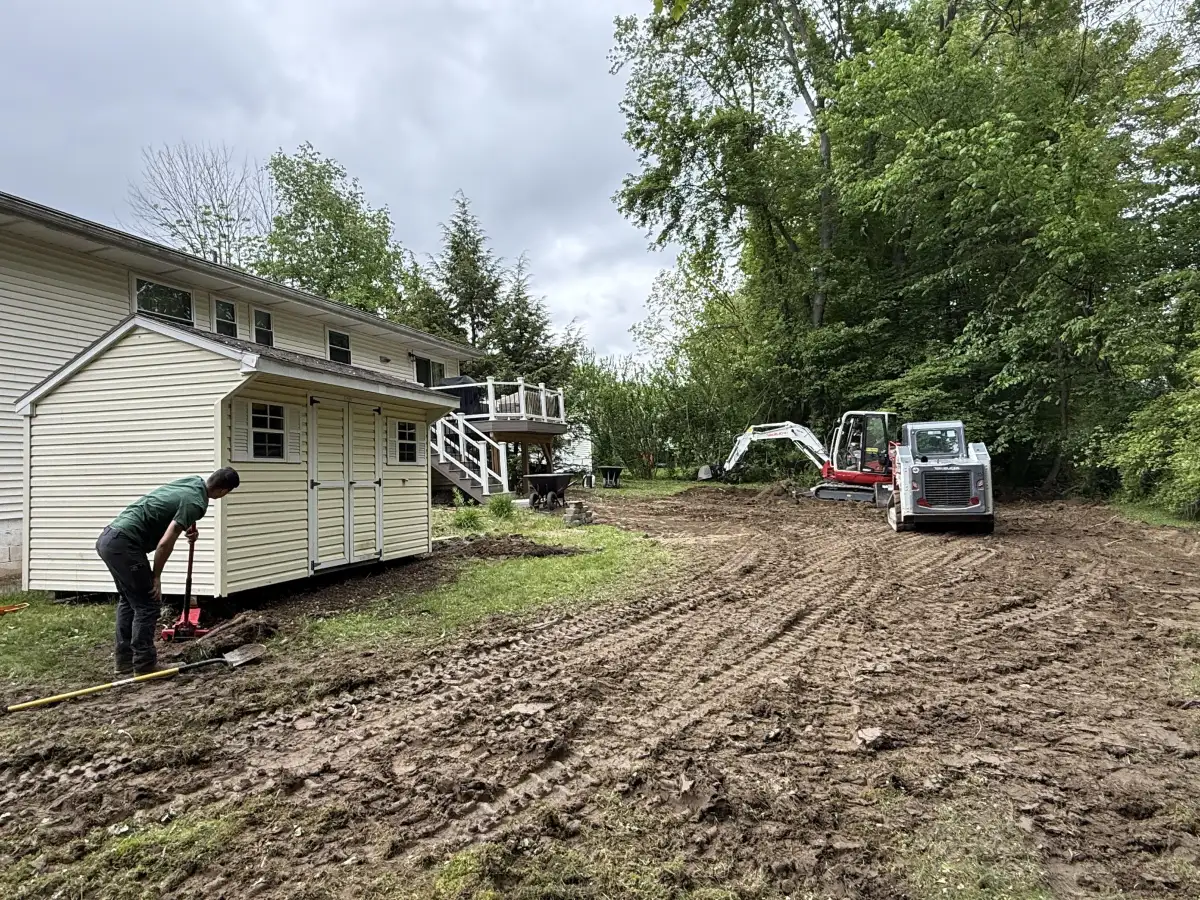
Separate the grading price into four parts
1. Getting equipment and materials into your yard
Gate width, side-yard clearance, steep approaches, staging space, and the distance from a delivery point all affect access. Show the entire route, including fences, paving, and planting you want protected. Include any necessary access changes and the repair of disturbed areas in the comparison.
2. Moving and handling soil
Clarify excavation, redistribution, imported fill or topsoil, loading, hauling, and disposal. Identify material quantities or allowances where available. Rock, buried obstructions, or unsuitable ground can change the work; the proposal should explain its assumptions and how additional work would be priced and approved.
3. Establishing a workable water route
A smoother lawn and a functioning drainage grade are different goals. The Building America Solution Center’s foundation-grading guidance explains how slopes away from a house help manage surface water and how constrained sites may need swales or drains. Your yard’s elevations and outlet need their own assessment.
If the proposed correction includes a swale, drain, or connection to an existing system, separate that scope from moving soil. Review the drainage service options alongside grading; do not assume an earthwork-only price includes them.
4. Leaving the surface ready for its next use
Rough grading establishes the broader ground shape. Finish grading prepares the final surface for its intended use. Confirm topsoil, seed or sod, erosion protection, cleanup, and access-route repairs individually. Bare graded soil and an established lawn are different handoff conditions. Ask what care the selected finish needs and who will provide it.
Compare the same finished result
Imagine two proposals for a low backyard area. One includes reshaping existing soil and leaving a rough surface. The other includes imported material, a drainage connection, finish grading, and lawn restoration. The lower total does not yet tell you which is better value: the proposals describe different results.
Have each estimate identify the work boundary, intended elevations or design reference, material handling, water route, and finish. Compare exclusions, allowances, taxes and fees, and the cost of any separate design or approvals. For work beyond grading, our excavation estimate guide covers the broader site-work scope.
Local requirements also belong in planning. The Town of Wappinger’s stormwater program discusses construction runoff and post-construction water management. It is a useful local resource, while the authority for your address must confirm which requirements apply to your proposed work. Establish responsibility for any needed design, approvals, and associated costs before accepting a proposal.
Where can you reduce the budget?
Ask whether a focused correction can meet your goal instead of reshaping the whole yard. Keep optional planting or decorative finishes separate from necessary earthwork and drainage. If a patio, driveway, or other excavation is planned, discuss the sequence before paying to finish a lawn that later equipment must cross.
Combining work may avoid repeated disturbance or setup, but savings depend on the actual scope. Keep necessary water management and surface protection in the plan. Cutting those items to reach a target price can leave the original problem unresolved.
Get a grading estimate for your yard
Send All American Lawn & Landscape your location, approximate work area, the problem you want to solve, and photos of both the yard and equipment access. For water concerns, include observations of where runoff comes from and where it collects. Share available plans and any future patio, driveway, or lawn work.
All American offers free estimates in its Dutchess County service area. Request a free grading estimate or call (845) 372-7768 to discuss the scope for your home.
Grading Cost Questions
Angi’s October 2026 national yard-leveling guide reports a typical range of $1,021–$3,330. That is a planning reference, not a Dutchess County price survey or an All American quote. The area, elevation changes, soil handling, access, drainage, and finished surface determine your project’s estimate.
Square footage describes the work area but leaves out the depth and volume of earth moved. Two equally sized yards can require very different amounts of imported soil, excavation, hauling, and restoration. Compare the proposed elevation changes and complete scope alongside the area.
Only if they are included in the proposal. Rough grading, finish grading, topsoil, seeding or sod, erosion protection, and access-route restoration are separate scope items to clarify. Identify the condition in which the yard will be left before comparing prices.
It may help when surface slopes are part of the problem, but standing water does not establish that grading alone is suitable. Roof runoff, ground conditions, existing drainage, and a suitable water route need review. Additional drainage work may change the budget.