If you own property in Dutchess County, there is a good chance you have dealt with — or will deal with — a slope that needs managing. The rolling terrain across Hopewell Junction, Fishkill, Beekman, and Wappingers Falls creates beautiful landscapes, but it also means hillsides that erode, yards that wash out during heavy rain, and driveways that slowly lose their edges. A properly built retaining wall solves these problems while adding real value to your property.
This guide covers everything you need to know before building a retaining wall in Dutchess County: the types available, how materials compare, what permits you need, when an engineer is required, and what you should expect to pay.
Why Retaining Walls Are So Common in Dutchess County
Three factors make retaining walls a near-necessity for many properties in our area:
- Hilly terrain: Dutchess County sits in the Hudson Valley foothills. Residential lots frequently include slopes of 15 to 30 degrees or more, especially in towns like East Fishkill and Beekman where homes are built into hillsides.
- Clay-heavy soil: Much of the soil in our region has a high clay content. Clay expands when wet and contracts when dry, which puts lateral pressure on foundations and causes slopes to creep downhill over time. This hydrostatic pressure is the number one reason retaining walls fail when they are not engineered correctly.
- Erosion from runoff: Between spring snowmelt and summer thunderstorms, water moves fast across Dutchess County properties. Without a retaining wall to hold the grade, soil washes away from yards, gardens, and the edges of driveways. We frequently see properties where years of unchecked erosion have created drop-offs that are both unsightly and unsafe.
A retaining wall holds back soil at a change in grade, turning an unusable slope into flat, functional space. Done right, it also manages water flow and protects your home's foundation from erosion damage. If you are also dealing with water pooling or soggy areas, check out our drainage solutions page — retaining walls and drainage systems often go hand in hand.
Types of Retaining Walls
Not every retaining wall is the same. The right type depends on the height you need, the soil conditions on your property, and your budget. Here are the five types we build most often:
Segmental Block Walls (Interlocking Concrete)
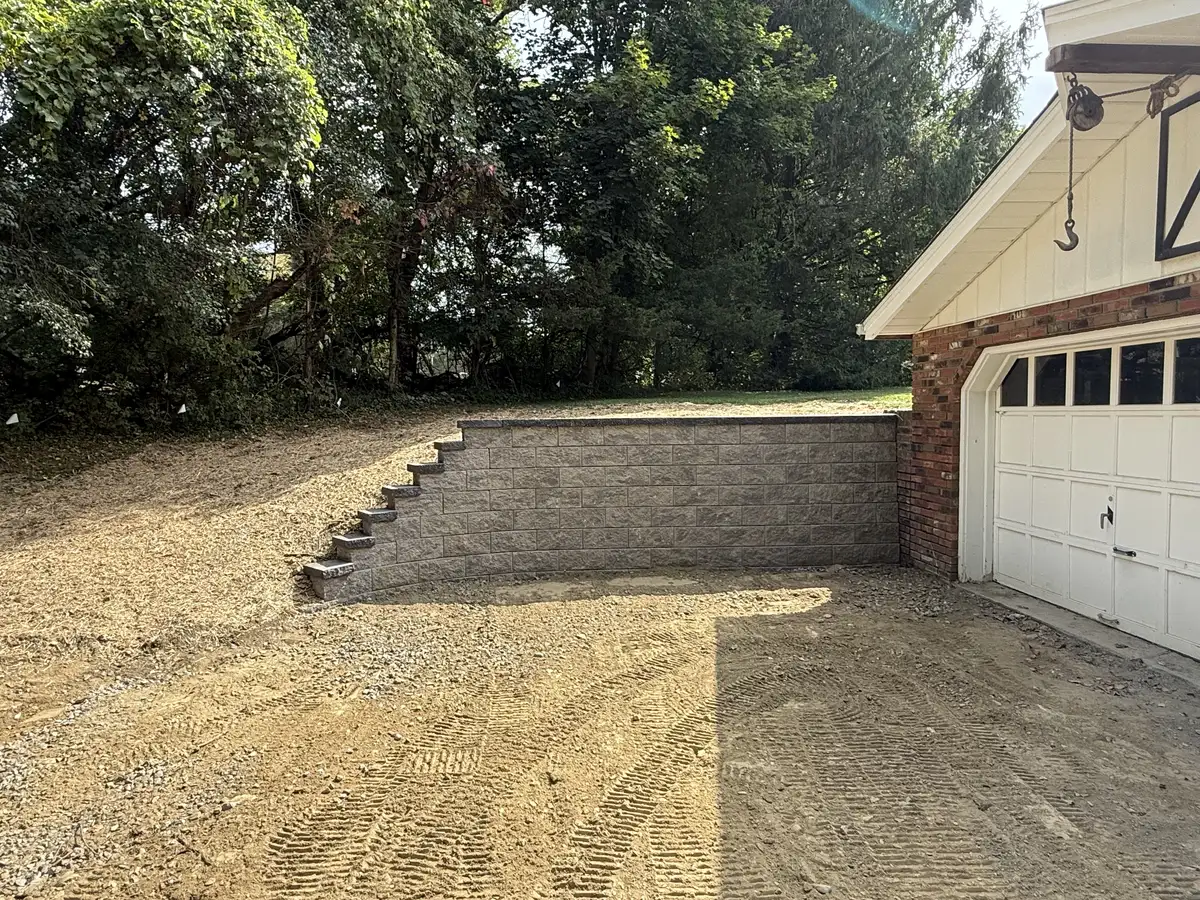
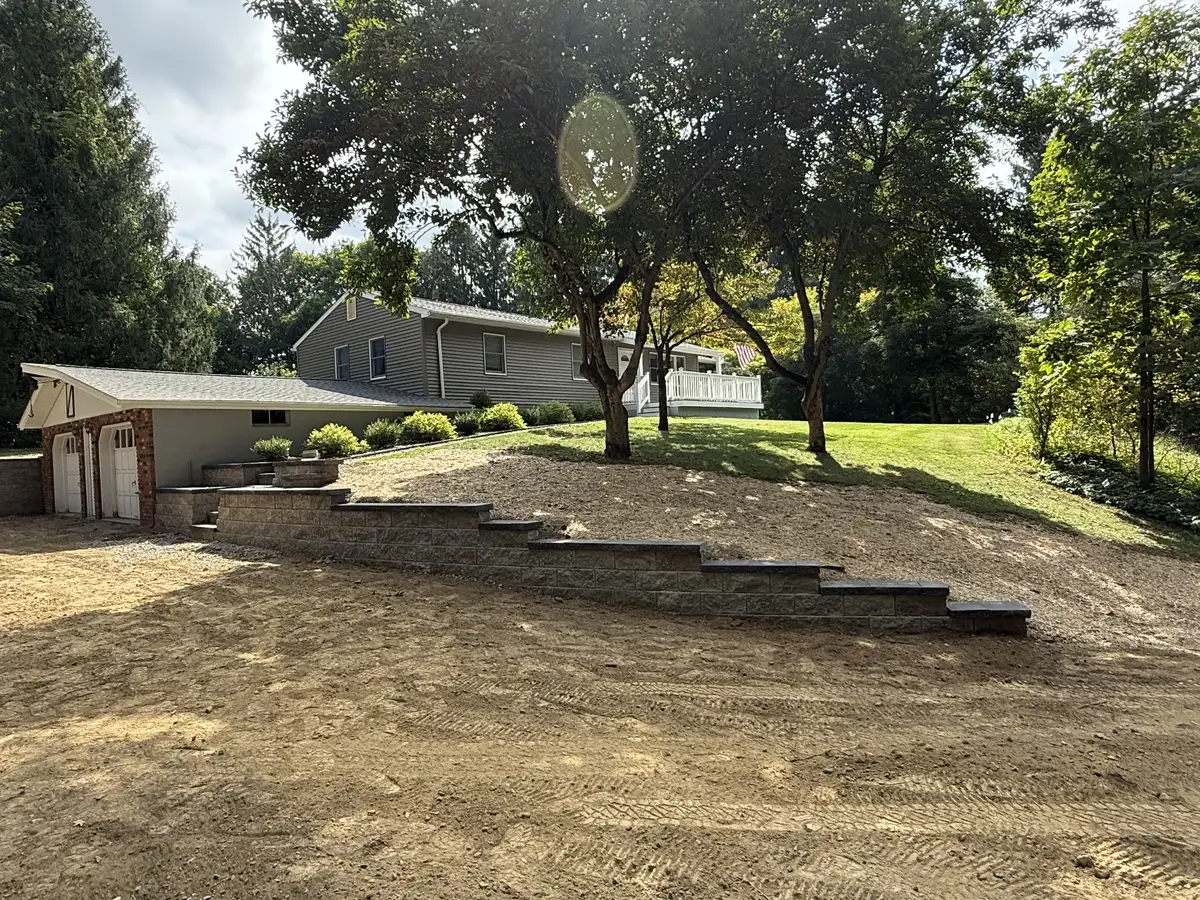
These are the most common retaining walls we install for residential properties. Segmental blocks are manufactured concrete units that lock together without mortar, relying on their weight and a built-in lip or pin system to resist soil pressure. They come in a range of colors and textures that mimic natural stone. For walls up to 4 feet, segmental blocks are hard to beat on cost and appearance. Taller walls require geogrid reinforcement — layers of high-strength fabric buried in the backfill at regular intervals to anchor the wall into the hillside.
Best for: Garden terraces, yard leveling, driveway edges, walls 2 to 6 feet tall.
Natural Stone Walls
Fieldstone and bluestone walls are a classic choice in the Hudson Valley. A well-built natural stone wall blends into the landscape and develops character with age. These can be dry-stacked (no mortar) for shorter walls or mortared for taller applications. Dry-stacked fieldstone walls are a traditional New England and Hudson Valley technique that works beautifully for walls under 3 feet. The irregular shapes create natural drainage gaps, which is an advantage in our wet climate.
Best for: Garden borders, landscape accents, properties with a rustic or traditional aesthetic.
Poured Concrete Walls
When you need maximum strength and height, poured concrete is the answer. These walls are reinforced with steel rebar and can handle significant soil loads. They are the standard choice for walls over 6 feet, foundation-adjacent walls, and commercial applications. The downside is appearance — bare concrete is not attractive. Most homeowners choose to face a poured concrete wall with stone veneer or stucco to improve the look.
Best for: Tall walls (6+ feet), structural applications, foundation protection, commercial sites.
Gravity Walls
Gravity walls rely purely on their own mass to resist soil pressure. They are typically built from large boulders, stacked concrete blocks, or gabion baskets (wire cages filled with stone). Boulder walls are a popular gravity wall option in Dutchess County because they look natural and the material is often available locally. They work well for walls up to 4 feet but become impractical at greater heights because the base needs to be extremely wide.
Best for: Decorative slopes, low walls under 4 feet, boulder-style landscape features.
Timber Walls
Pressure-treated landscape timbers are the most affordable retaining wall option. They are quick to install and work for short walls in garden and landscape applications. However, timber walls have a limited lifespan — even pressure-treated wood will rot after 15 to 20 years in contact with soil. In Dutchess County's wet climate, we generally steer clients toward concrete or stone for anything structural, reserving timber for raised garden beds and low decorative borders.
Best for: Raised beds, garden borders, budget-conscious projects under 3 feet.
Material Cost Comparison
Here is what you can expect to pay for a professionally installed retaining wall in Dutchess County, including materials, labor, excavation, drainage, and backfill:
- Timber: $25 to $35 per square foot of wall face
- Segmental block (concrete): $30 to $50 per square foot
- Natural stone (dry-stacked): $35 to $55 per square foot
- Natural stone (mortared): $40 to $65 per square foot
- Poured concrete (with veneer): $50 to $75 per square foot
- Boulder / gravity wall: $30 to $55 per square foot
The square footage is calculated from the exposed face of the wall (height times length), not the footprint. A wall that is 3 feet tall and 40 feet long has 120 square feet of face. Site conditions — steep access, rocky soil, or the need for significant excavation — can push costs toward the higher end of these ranges.
Permits and Engineering Requirements in Dutchess County
Building codes for retaining walls vary by town in Dutchess County, but here are the general rules that apply across most municipalities:
When You Need a Permit
In most Dutchess County towns — including East Fishkill, Fishkill, Wappinger, and the Town of Poughkeepsie — a building permit is required for any retaining wall over 4 feet tall, measured from the bottom of the footing to the top of the wall. Some towns measure from grade to top, which can make a difference on sloped sites. Always check with your local building department before starting. We handle the permit process for our clients as part of the project.
When You Need a Structural Engineer
Any wall over 4 feet typically requires stamped engineering drawings as part of the permit application. The engineer designs the wall's footing depth, reinforcement schedule, drainage system, and geogrid layout based on a soil analysis specific to your property. Skipping this step is not just illegal — it is dangerous. An under-designed retaining wall can fail catastrophically, especially during spring thaw when hydrostatic pressure spikes.
Even for walls under 4 feet, we recommend consulting an engineer if the wall is near a structure, supports a driveway or parking area, or sits on known problem soils (heavy clay or fill).
Drainage Behind the Wall: The Most Critical Detail
More retaining walls fail because of poor drainage than any other single cause. Water that builds up behind a wall creates hydrostatic pressure that pushes the wall outward. In Dutchess County's clay soils, this pressure can be enormous because clay holds water instead of letting it pass through.
Every retaining wall we build includes a complete drainage system behind it:
- Drainage aggregate: A 12-inch-wide column of clean crushed stone runs the full height and length of the wall behind the blocks or stone. This creates a path for water to flow downward instead of building up pressure.
- Perforated drain pipe: A 4-inch perforated pipe sits at the base of the wall, wrapped in filter fabric to prevent clogging. This pipe collects water from the drainage aggregate and carries it to a daylight outlet or a connection to the property's storm drainage system.
- Filter fabric: A layer of non-woven geotextile fabric separates the drainage stone from the native soil. Without this fabric, fine clay particles migrate into the stone and clog the drainage system within a few years.
If your property already has water management issues, combining a retaining wall with a French drain system is often the smartest investment. We design both systems together so they work as one integrated solution.
DIY vs. Professional Installation
For a small garden border wall under 2 feet, a handy homeowner with the right materials can handle the job. Beyond that, retaining walls are not a DIY project. Here is why:
- Base preparation is everything. A retaining wall sits on a compacted gravel base that must be perfectly level and extend below the frost line (42 inches in Dutchess County). Getting this wrong means the wall shifts and leans within a few freeze-thaw cycles.
- Soil pressure calculations matter. The amount of weight a wall needs to hold back increases exponentially with height. A 4-foot wall does not hold back twice as much soil as a 2-foot wall — it holds back roughly four times as much. Under-building a retaining wall is not something you discover until it fails.
- Equipment is required. Even a modest retaining wall project involves excavating soil, hauling gravel, and placing heavy blocks or stone. We use compact excavators and skid steers to do in a day what would take a homeowner weeks with a wheelbarrow. Visit our excavation services page to see the equipment we bring to these jobs.
- Liability and insurance. If a DIY retaining wall fails and damages a neighbor's property or injures someone, your homeowner's insurance may not cover it — especially if the wall required a permit and engineering that were never obtained.
Our recommendation: anything over 2 to 3 feet tall should be professionally designed and built. The cost of doing it right the first time is always less than tearing out a failed wall and rebuilding.
Choosing the Right Wall for Your Property
The best retaining wall for your project depends on a few key factors:
- Height needed: Under 3 feet opens up all options including timber and dry-stacked stone. Between 3 and 6 feet, segmental block with geogrid is the best value. Over 6 feet, poured concrete with engineering is typically required.
- Aesthetic preference: Natural stone looks best in wooded, rural settings. Segmental block offers the widest range of modern and traditional looks. Boulders work for a rugged, natural appearance.
- Budget: Timber is cheapest upfront but has the shortest lifespan. Segmental block offers the best long-term value for most residential projects. Natural stone and poured concrete cost more but last indefinitely with proper drainage.
- Purpose: A wall holding back a hillside behind your house needs to be engineered differently than a decorative terrace in a garden bed. Be honest about the structural demands — this is not the place to cut corners.
Get a Professional Assessment
Every retaining wall project starts with evaluating the slope, soil conditions, drainage patterns, and how the wall connects to the rest of your property. We do this assessment on-site during a free consultation — no guesswork, no generic estimates. Take a look at our hardscaping services for more on the walls, patios, and outdoor features we build across Dutchess County.
Ready to solve your slope problem? Request your free estimate online or call (845) 372-7768 to schedule a site visit.