
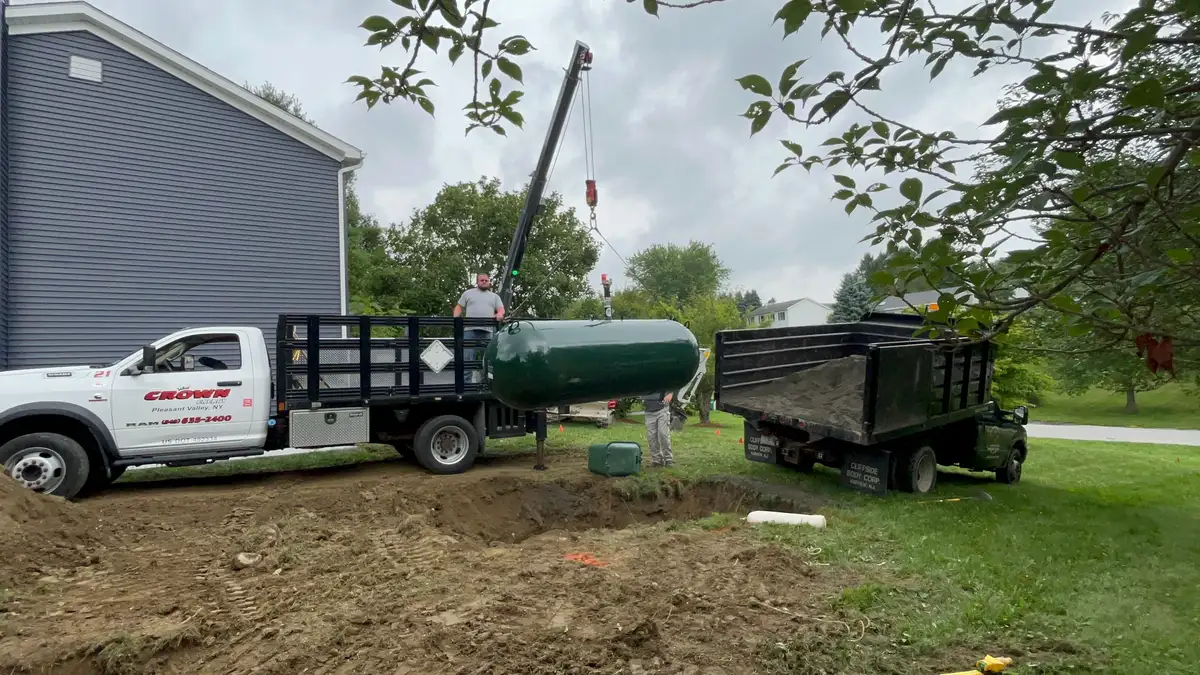
Begin with the propane supplier and the intended use
A new tank has to suit the equipment it will supply, the delivery arrangement, and the actual property. Give your propane supplier the appliance information and intended use before choosing a tank size or location. House floor area alone does not determine the correct installation.
Propane installation and service require qualified professionals. The Propane Education & Research Council’s safety guidance explains why work on propane equipment should not be attempted as a homeowner installation project.
Above ground and underground: compare the whole arrangement
An above-ground installation leaves the tank visible and accessible. Its location still needs appropriate support, clearances, delivery access, and protection as established for the actual equipment and site. Screening should be discussed with the supplier before a fence or planting is placed around it.
An underground installation changes the excavation, access, inspection, and maintenance responsibilities. The tank, protective systems, ground conditions, and proposed surroundings need to be considered together. Do not treat burial as a way to avoid placement requirements or assume that every tank is suitable for underground use.
If you are considering ownership, review the responsibilities described in PERC’s underground tank ownership information with the supplier. Ownership and leasing arrangements should be compared from their actual written terms.
Set the location before arranging earthwork
The supplier and relevant professionals should establish the tank location, clearances, support, utility route, access, and applicable approval requirements. Show them buildings, boundaries, drives, drainage features, slopes, and known underground or private services.
Confirm the required utility locating and site preparation before excavation. An online list of generic tank distances or hole dimensions is not a site plan. Do not begin digging from an assumed standard depth or a photograph of another installation.
Confirm the Full Installation Scope
All American provides full propane tank installation, alongside excavation and landscaping services. Discuss the selected tank, its proposed location and the surrounding site work together so the estimate describes the installation you need.
Keep responsibilities identifiable: site preparation, tank supply and placement, protective systems, gas work, testing, approvals, and commissioning may involve different professionals. Confirm that the proposed schedule connects those activities before equipment arrives.
Include the finish and future access
Discuss where excavated material will go and what the disturbed area should look like afterward. Seed, topsoil, paving repair, or other restoration should be included or excluded clearly. Preserve the access needed for delivery, inspection, and maintenance; landscaping decisions should be coordinated with those needs.
Show future driveways, patios, walls, or planting on the plan. Moving a feature later is a different scope from arranging it correctly within the current project.
Compare a complete estimate
The estimate should distinguish the tank arrangement from excavation, removal, support, utilities, professional installation, approvals, and restoration. Ground conditions, access, the chosen equipment, and the work limits affect price and timing. No generic local price difference establishes what an above-ground or underground installation will cost at your home.
Request a free propane tank installation estimate from All American for your Hopewell Junction or Dutchess County home. Share your address, equipment information, access photos and whether you are planning a new installation or a replacement.