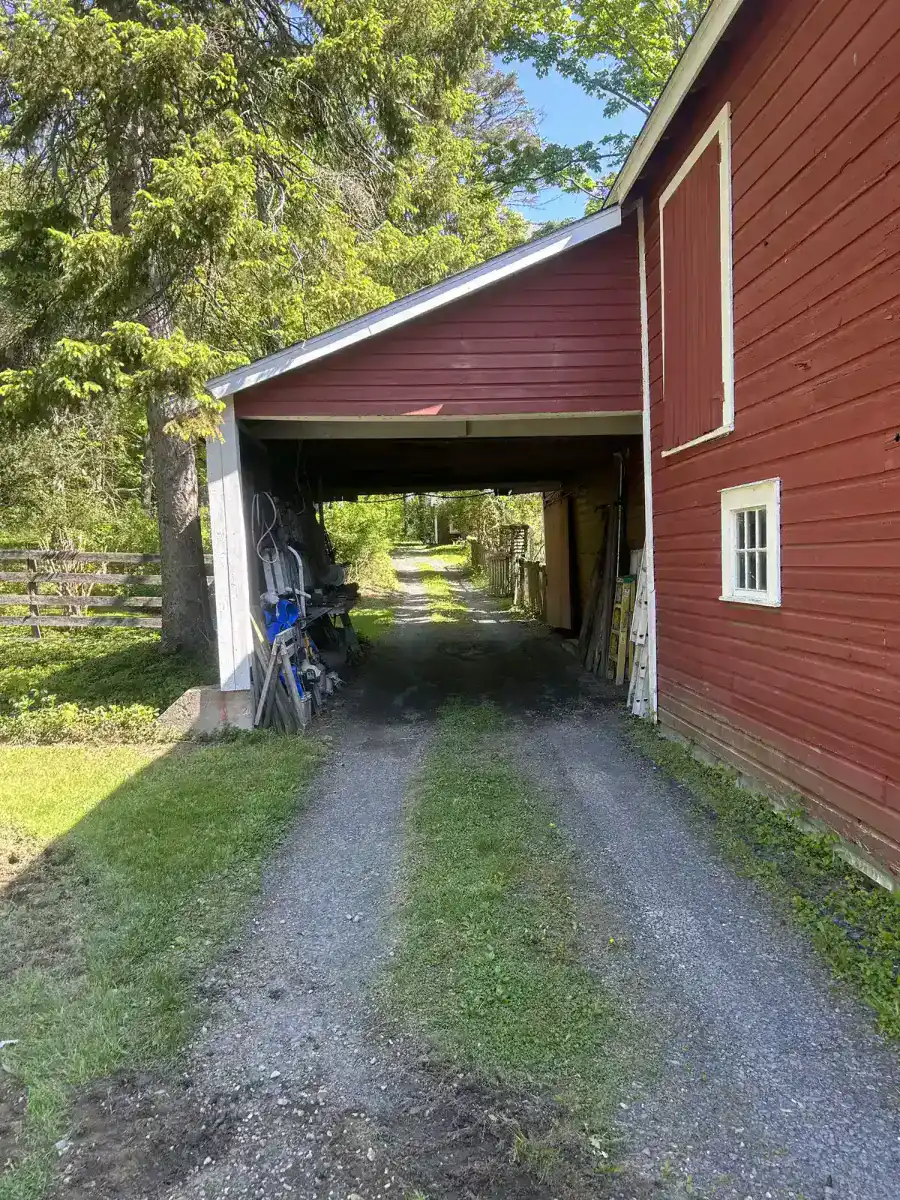
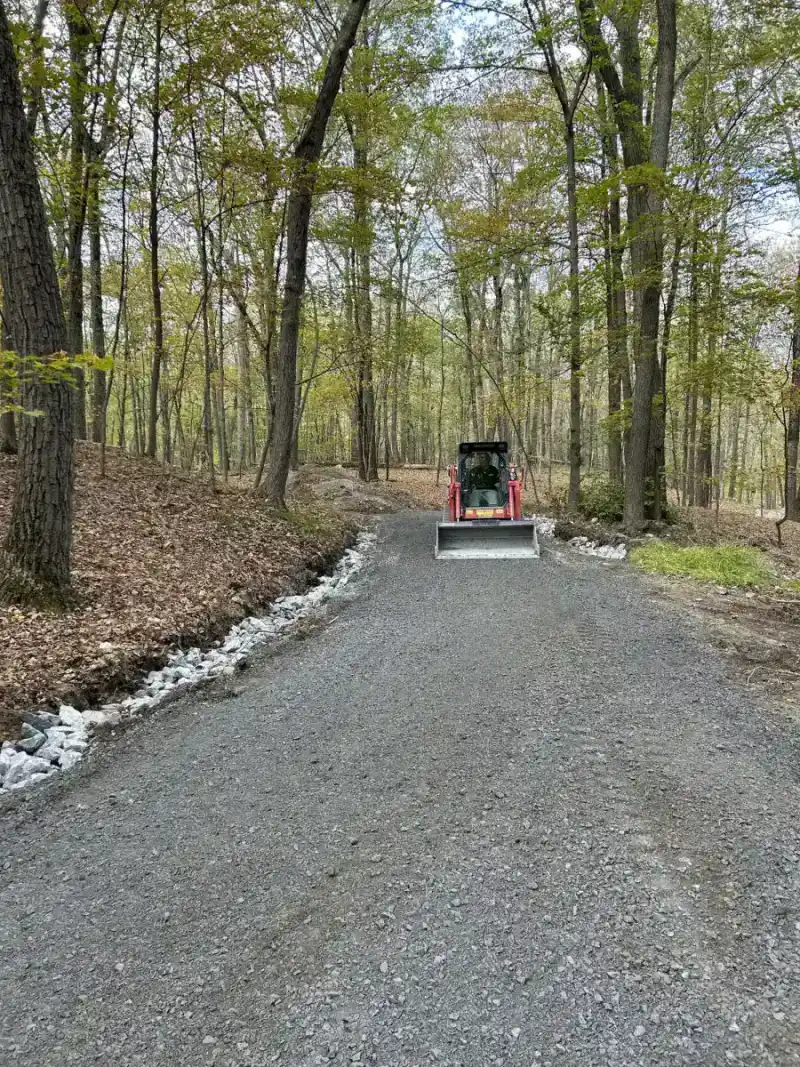
Dutchess County is home to thousands of long, rural driveways. Many of them stretch hundreds of feet from the road to the house, winding through wooded lots and over hilly terrain. When it comes time to build a new driveway or resurface an existing one, most property owners here narrow their options down to two materials: crushed stone gravel or recycled asphalt millings. Both are far more affordable than full asphalt paving, but they perform differently depending on your property. Here is a straightforward comparison to help you decide which one is the better fit.
What Is Crushed Stone Gravel?
Crushed stone gravel is exactly what it sounds like: natural rock that has been mechanically crushed and screened to a specific size. In the Hudson Valley, the most common grades used for driveways are:
- #2 stone: Roughly 2 to 3 inches in diameter. Used as a base layer for drainage and structure.
- #3 stone: About 1 to 2 inches. Another common base stone, slightly smaller than #2.
- Item 4 (process or crusher run): A mix of crushed stone and stone dust ranging from fine powder up to 1.5 inches. This is the most common surface layer for gravel driveways because the fine particles pack down and bind together, creating a firmer surface than uniform-sized stone.
A well-built gravel driveway typically has a base of #2 or #3 stone topped with 3 to 4 inches of Item 4. The base provides structure and drainage while the top layer gives you a smooth, driveable surface.
What Are Asphalt Millings?
Asphalt millings are recycled asphalt pavement. When a paved road or parking lot is resurfaced, the old asphalt is ground up by a milling machine into small, irregular chunks. These chunks still contain the original petroleum binder that held the asphalt together. That residual binder is what makes millings behave differently from plain gravel. When spread and compacted, millings gradually re-bind under heat and traffic, creating a semi-solid surface that is harder and more cohesive than loose stone.
Millings are available from most excavation and paving suppliers in the Dutchess County area. Availability can be seasonal since millings are a byproduct of road construction, and paving season in New York runs roughly from April through November.
Cost Comparison
Both materials are affordable compared to full asphalt paving or concrete, but millings tend to be slightly cheaper:
- Crushed stone gravel: Roughly $15 to $30 per ton delivered, depending on the grade and quarry distance. Item 4 is typically at the lower end, while decorative stone costs more.
- Asphalt millings: Roughly $10 to $25 per ton delivered. Millings are a recycled product, so the material cost is lower. However, availability can affect pricing. When road construction slows down, millings become scarcer and prices rise.
For a 300-foot driveway that is 12 feet wide and needs 4 inches of surface material, you are looking at approximately 80 to 100 tons of material. At those quantities, even a $5 per ton difference adds up. Factor in delivery, spreading, and compacting, and a typical driveway project in Dutchess County runs between $3,000 and $8,000 for either material, depending on length, width, and site preparation needed.
Durability and Compaction
This is where the two materials diverge most. Asphalt millings compact into a significantly harder surface than gravel. As traffic drives over millings and the sun heats them, the residual binder reactivates and the material bonds together almost like fresh asphalt. After a full season of compaction, a millings driveway can feel nearly as solid as a paved surface.
Gravel, on the other hand, stays loose. Item 4 packs down reasonably well, but it never truly binds the way millings do. Over time, gravel migrates to the edges of the driveway, gets pushed into ruts by tire tracks, and needs to be regraded and replenished more frequently.
Drainage
Gravel wins on drainage. Because gravel stays loose and permeable, water passes through it easily. This makes gravel driveways a strong choice on flat properties where you want rainwater to soak into the ground rather than run off.
Millings compact into a denser surface that sheds water rather than absorbing it. On flat driveways, this means you need to crown the surface (build it slightly higher in the center) so water runs to the sides. On sloped driveways, water channels down the surface and can cause erosion at the base of the slope if no drainage provisions are in place. Proper grading and drainage solutions are important with millings on any slope.
Hills and Slopes
If your driveway has any meaningful grade to it, millings are the better choice. The self-binding property of millings means they lock together on slopes and resist washing out during heavy rain. Gravel on a steep driveway is a constant maintenance headache. Every rainstorm pushes loose stone downhill, leaving ruts and bare spots at the top and piles of displaced gravel at the bottom.
Dutchess County has plenty of hilly properties, especially in Beekman, East Fishkill, and the areas east of Route 9. We have installed millings driveways on grades that would be impractical with gravel. For any driveway with more than a 5 to 8 percent slope, millings are almost always the smarter investment.
Maintenance
Both materials require periodic maintenance, but the type and frequency differ:
- Gravel driveways typically need regrading once or twice a year, plus fresh material (top-dressing) every 2 to 3 years. Potholes form faster in gravel, especially during spring thaw when the ground is soft and saturated. Snow plowing also displaces gravel, so spring cleanup is an annual task.
- Millings driveways need less frequent attention. Once compacted and bonded, millings hold their shape much longer. You may need to add fresh millings and regrade every 3 to 5 years. Potholes are less common because the surface is more cohesive. However, the edges of a millings driveway can crumble over time if they were not compacted well during installation.
For both materials, proper installation makes the biggest difference in long-term maintenance costs. A driveway built on a solid, well-drained base with correct grading will outperform one that was just dumped and spread, regardless of the surface material.
Appearance
This comes down to personal preference. Crushed stone gravel, especially Item 4, has a clean, light gray or tan appearance that blends naturally with the surrounding landscape. It looks like a classic country driveway.
Asphalt millings are dark gray to black when fresh and fade to a medium gray over time. A freshly compacted millings driveway looks very similar to a paved asphalt surface. Some homeowners prefer this look because it gives the property a more finished, polished appearance. Others find it too industrial for a rural setting.
The Environmental Angle
Asphalt millings are a recycled material. Using millings keeps old pavement out of landfills and reduces the demand for newly quarried stone. If sustainability matters to you, millings have a clear edge. That said, both materials are relatively low-impact compared to full asphalt paving or concrete, which require significantly more energy and raw materials to produce.
Which Should You Choose?
The right material depends on your property:
- Choose asphalt millings if your driveway is long, steep, or has curves on hills. Millings grip the slope, compact harder over time, and require less frequent top-dressing. They are also the better option if you want a surface that looks and feels close to pavement without the cost.
- Choose crushed stone gravel if your driveway is relatively flat and short, if drainage is a priority, or if you prefer the traditional gravel look. Gravel is also easier to work with for DIY repairs since it does not require a roller or heavy compaction equipment.
For driveways that are both long and steep, we almost always recommend millings. We have built and resurfaced driveways up to half a mile long across Dutchess County, and on anything over a few hundred feet with elevation changes, millings consistently outperform gravel in longevity and owner satisfaction.
Get a Free Driveway Estimate
Not sure which material is right for your driveway? We will come out, walk your property, evaluate the grade and soil conditions, and give you a clear recommendation along with a written estimate. Request a free quote or call us at (845) 372-7768. We serve Hopewell Junction, Wappingers Falls, Fishkill, Beekman, East Fishkill, Poughkeepsie, LaGrange, and all of Dutchess County.